Article
The Tools of Spirit Conjuring #1: The Magician’s Shopping List
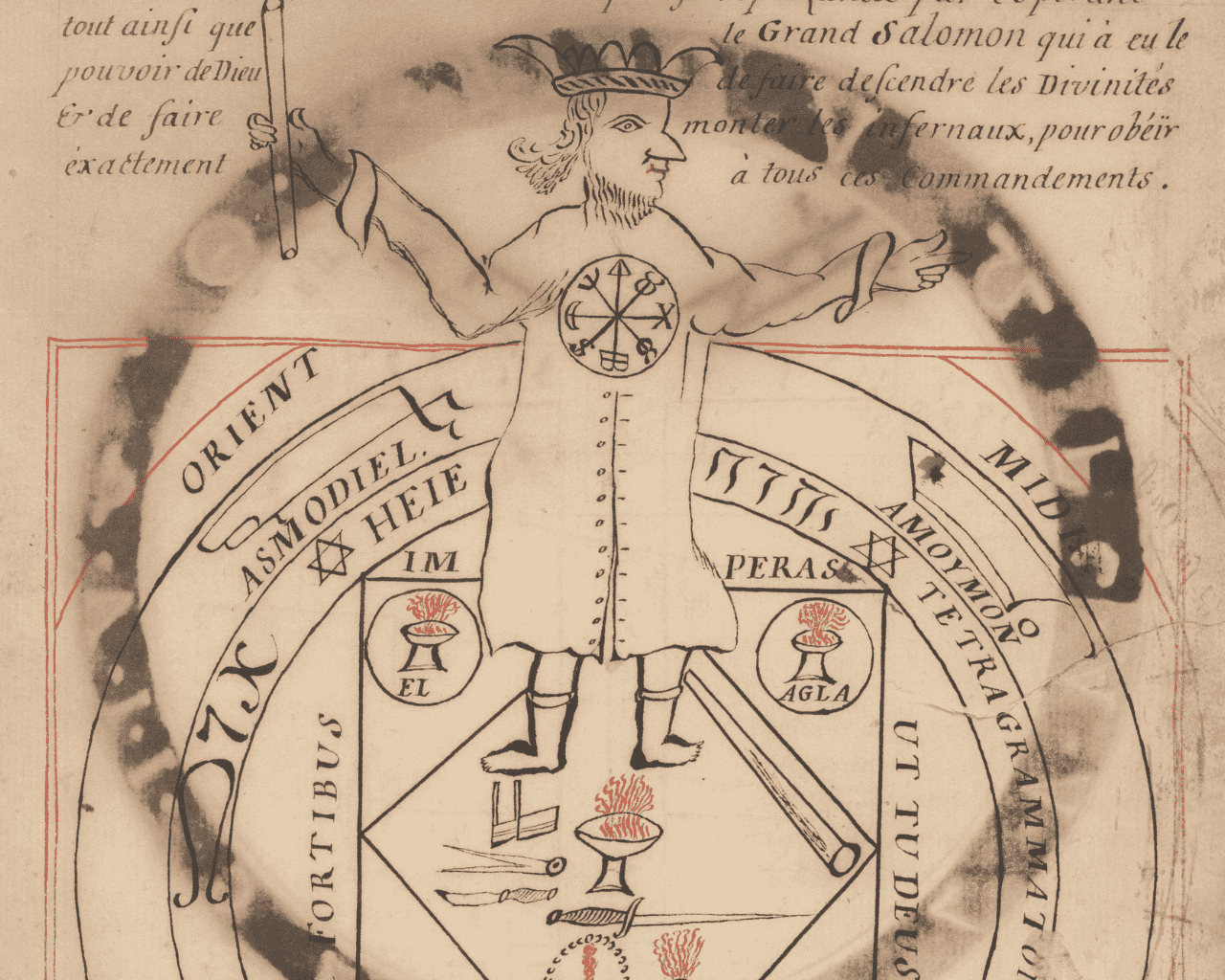
Spirit conjuring as it emerged in the thirteenth century offered masters or operators, as magicians were known back then, an opportunity to engage with spirits through elaborate rituals, known as experiments or operations. Taking weeks and sometimes years, magic operations granted access to secret knowledge and occult powers from the spirit world. They were characterized by actions and speech acts as prayers and conjurations at specific times and places, tailored to the spirit invocated and the purpose of the operation.1 Operators not only did and said something, however; they also needed a well-stocked toolkit, ranging from the mundane (a piece of chalk) to the sacred (a book). In this series of articles, I will examine the tools that spirit conjurors used, some of which, like the circle and the wand, became emblematic of the ritual magic.
Spirit conjuring texts survive piecemeal in manuscripts (handwritten books) from the fourteenth and fifteenth centuries, and in larger numbers from the sixteenth century onwards. It is in these magic books that we find clues as to what operators needed to practise their art. Comprehensive treatises to the art of spirit conjuring exist, such as the Key of Solomon, which has chapters on individual tools, including a ridiculously extensive set of wands and knives that would put a present-day amateur chef to shame.2 Yet most spirit conjuring manuscripts contain magic bits and pieces: enigmatic notes (‘you must never keepe any [spirit] inclosed [in a stone] above 24 howers’), single operations and parts of operations, such as a conjuration or a design for a circle for a specific type of spirit.3 This implies that many operators did not rely on comprehensive treatises, but instead assembled their operations from scratch, much like we would put together a LEGO set. Except that in the case of magic manuscripts there will be some bricks missing, while others are in a different colour or from another set; and the building instructions are in disarray or incomplete, or from a completely different set altogether. It may be for these reasons that operators sometimes formulated lists of ‘requisites for the art of necromancy,’ as one manuscript has it.
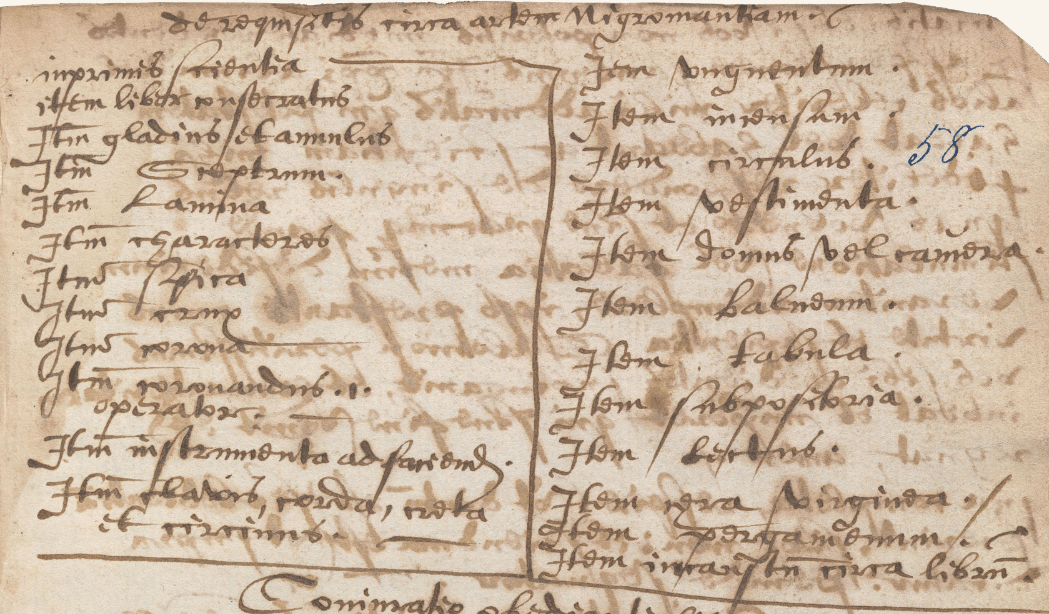
The inventory lists the following items:4
- Firstly, knowledge
- further, a consecrated book
- a sword and a ring
- a sceptre
- a lamina
- caracteres
- knowledge of the heavenly motions
- a cross
- a crown
- a crowned one, that is, an operator
- instruments for making or doing something:
- a key, a cord, chalk and a pair of compasses
- an ointment
- incense
- a circle
- vestments
- a house or chamber
- a bath
- a table
- a suppository5
- a bed
- virgin wax
- parchment
- ink for the book
Even a cursory look at this list from a late sixteenth-century English manuscript reveals that spirit conjuring relied on a surprisingly large and varied set of items. Items as the operator and the circle are expected. Yet who would have thought that a chamber, a table, a bath and a bed were indispensable, let alone a cord and a piece of chalk? And what is knowledge of the heavenly motions good for? What is more, some items seem to be missing. There is, for instance, no mention of the spirits that give spirit conjuring its name. Prayers and conjurations are not included either, and neither is the knife with which the operator had to shave his beard and clip his nails—toes included. And what about the staff or wand that is the trademark of the proverbial wizard?
Whenever I see inventories like the one above in magic manuscripts, I picture the operator, shopping list in hand, frantically visiting tradesmen to buy or order items, only to discover upon returning home that the list was both incomplete and overcomplete. Some items which are needed for almost any operation are not on the list, like the broom, while other items are on the list, but are only used in a few operations, like the table. The same holds for the following inventory:
- A sworde
- a septer
- a crowne
- a ringe
- a circle
- holly seales
- pictures
- vestmentes
- oyle consecrated
- virgin parchment
- the pentacle
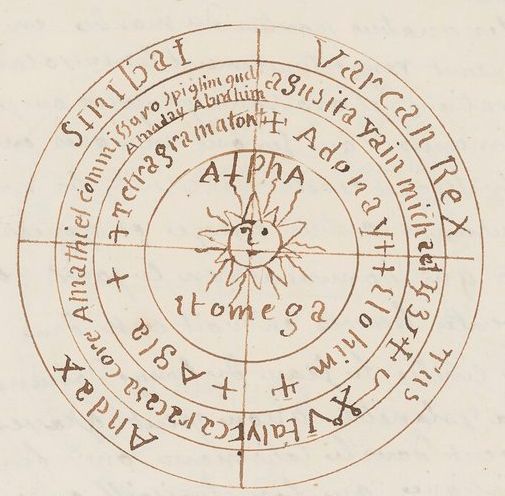
This inventory from a seventeenth-century manuscript is incomplete for even the simplest operation.6 But at the same time it has items that are only used in very specific operations, such as pentacles. A special type of magic sigil, pentacles are not going to be of much use in common operations like those for a magic flying horse or for conjuring the fairy king, Beelzebub or Azazel, spirit prince of the ghosts of dead people. If the aim was to conjure Varcan, spirit king of the Sun, on the other hand, the operator would be ill-advised not to have a pentacle at the ready, because astral spirits tend to be wayward when not invocated properly.
It is unfair, though, to project our preoccupation with categorizing and systematizing onto the past. One need only think of the absurd list of animals from the Celestial Emporium of Benevolent Knowledge in Jorge Luis Borges’ essay ‘John Wilkins’ Analytical Language,’ to see not only the futility but also the folly of striving for comprehensiveness.7 The operators who wrote the inventories may not have intended to be comprehensive. Even so, the lists offer insights into the kinds of items that were considered useful in spirit conjuring. I will examine them one by one in subsequent articles in this series, starting with the first item on the list: knowledge.
——————————
1 Studies of medieval and early modern spirit conjuring are, among others, Daniel Harms, James R. Clark and Joseph H. Peterson, The Book of Oberon: A Sourcebook of Elizabethan Magic (Woodbury, 2015), Richard Kieckhefer, Magic in the Middle Ages (Cambridge, 1989) and Forbidden Rites: A Necromancer’s Manual of the Fifteenth Century (University Park, 1997), Frank Klaassen, The Transformations of Magic: Illicit Learned Magic in the Later Middle Ages and Renaissance (University Park, 2013), and Phil Legard and Alexander Cummins, An Excellent Booke of the Arte of Magicke: The Magical Works of Humphrey Gilbert & John Davis from British Library Additional Manuscript 36674 (London, 2020).
2 See Stephen Skinner and David Rankine, The Veritable Key of Solomon (Singapore, 2008).
3 London, British Library, Add. MS 36674, fol. 48r. See also London, British Library, Sloane MS 3883, fol. 32v.
4 London, Wellcome Library, MS.110, fol. 58r. A closely similar list is in London, British Library, Sloane MS 3318, fol. 16v. Quoted texts in languages other than English have been translated by me. Medieval and early modern English is quoted in the original.
5 The Latin term ‘suppositorium’ has several medical meanings that do not fit the spirit conjuring context. One of the non-medical meanings that developed in medieval Latin is that of a paten, which could be a dish but also a thin metal plate. See J. F. Niermeyer, Mediae latinitatis lexicon minus (Leiden, 1976), p. 1008; Oxford English Dictionary, ‘paten (n.),’ September 2026, https://doi.org/10.1093/OED/1135497539.
6 London, British Library, Sloane MS 3850, fol. 114v.
7 Jorge Luis Borges, ‘John Wilkins’ Analytical Language,’ in The Total Library: Non-Fiction, 1922-1986, ed. Eliot Weinberger (London, 1999).


Subscribe to the MarcoToday newsletter
and join the conversation.